The Secret Behind Great AI Results: It’s Not the AI, It’s the Prompt
Artificial Intelligence has become one of the most powerful productivity tools available today. Yet many people still struggle to get useful results.
The reason is simple:
- Most users focus on the AI model.
- The best users focus on the prompt.
Whether you’re using ChatGPT, Claude, Gemini, or Copilot, the quality of your results depends largely on the instructions you provide.
Let’s explore how to create better prompts and dramatically improve your AI outputs.
Why Most AI Prompts Fail
Many users type prompts like:
“Write a social media post.”
“Create a marketing strategy.”
“Help me with my business.”
These requests are too broad.
When the instructions are vague, the AI has to guess what you want, often producing generic responses that lack depth, context, and relevance.
The solution is to structure your prompts correctly.
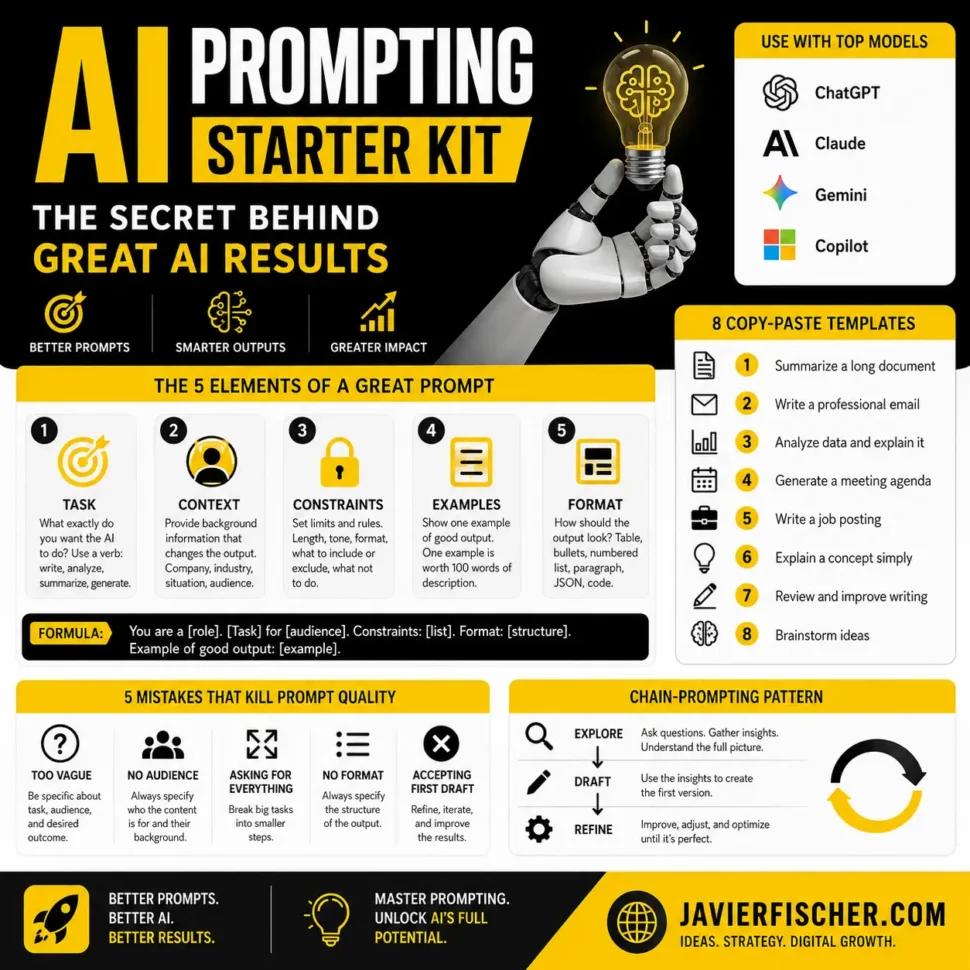
The 5 Elements of a Great Prompt
Every high-performing prompt contains five essential components.
1. Task
Tell the AI exactly what you want it to do.
Examples:
- Write
- Analyze
- Compare
- Summarize
- Generate
- Brainstorm
Instead of:
“Help me with marketing.”
Try:
“Create a 30-day social media content strategy.”
2. Context
Provide background information.
The more context you give, the more relevant the output becomes.
Include:
- Industry
- Company type
- Audience
- Goals
- Current situation
Example:
“I run a digital marketing agency that serves small businesses in the United States.”
3. Constraints
Define the rules.
Examples:
- Maximum word count
- Desired tone
- What to avoid
- Target audience
- Platform requirements
Example:
“Keep the response under 500 words and use a professional tone.”
4. Examples
Examples are one of the fastest ways to improve AI performance.
Instead of describing what you want, show it.
A single example often produces better results than several paragraphs of explanation.
5. Format
Tell the AI how to organize the response.
Examples:
- Bullet points
- Table
- Numbered list
- Blog article
- JSON
Example:
“Present the answer in a table with columns for Strategy, Benefit, and Priority.”
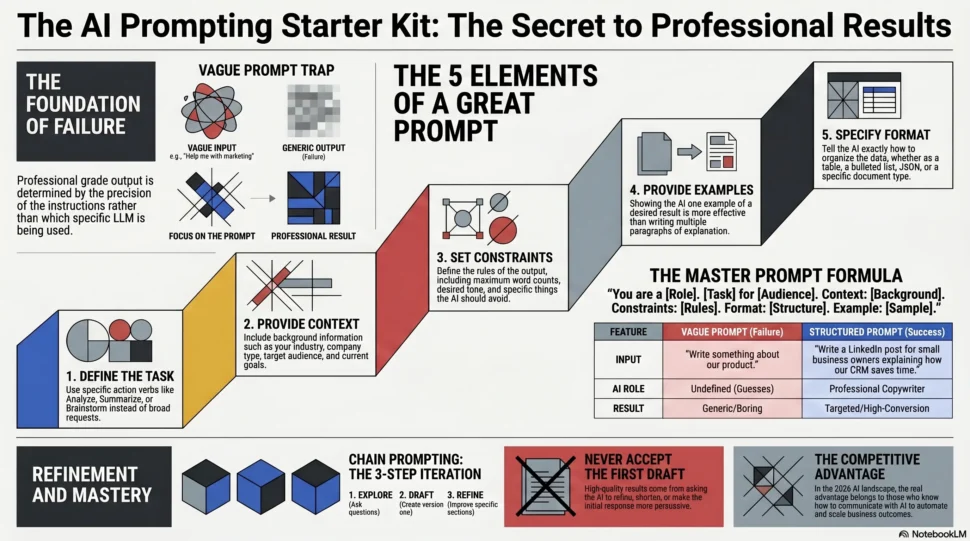
The Prompt Formula That Works
Use this simple structure:
You are a [role].
[Task] for [audience].
Context: [background information].
Constraints: [rules and limitations].
Format: [desired structure].
Example: [sample output].
This framework alone can significantly improve your results.
5 Mistakes That Kill Prompt Quality
Mistake #1: Being Too Vague
Bad Prompt:
“Write something about our product.”
Better Prompt:
“Write a LinkedIn post for small business owners explaining how our CRM software saves time.”
Mistake #2: Ignoring the Audience
Always specify who the content is for.
A CEO, marketer, developer, and customer all need different explanations.
Mistake #3: Asking for Everything at Once
Don’t ask AI to solve a massive project in a single prompt.
Break the process into smaller steps.
Mistake #4: Not Specifying the Output Format
Structure matters.
Always tell the AI exactly how you want the information delivered.
Mistake #5: Accepting the First Draft
- The first response is rarely the final answer.
- Refine it.
- Ask for improvements.
- Request examples.
- Make it shorter.
- Make it more persuasive.
- Iteration is where the magic happens.
The Power of Chain Prompting
Professional AI users rarely rely on a single prompt.
Instead, they use a process called Chain Prompting.
Step 1: Explore
Ask questions.
“What information do I need before creating a marketing plan?”
Step 2: Draft
Use the answers to create the first version.
“Using those insights, create a marketing plan.”
Step 3: Refine
Improve specific sections.
“Rewrite the social media strategy with more detailed examples.”
This approach consistently produces better results than trying to generate everything at once.
The Future Belongs to Better Prompts
AI is becoming more powerful every month.
But the real competitive advantage isn’t simply having access to AI.
It’s knowing how to communicate with it.
The people who learn prompt engineering today will create better content, make faster decisions, automate more work, and achieve better business outcomes.
The next time AI gives you a poor result, don’t blame the model.
Improve the prompt.
That’s where the real power begins.