Many businesses invest in Digital Marketing, SEO, social media, or paid advertising expecting immediate sales.
However, one of the biggest mistakes companies make is trying to sell directly to people who are not yet ready to buy.
This is where marketing funnels — also known as sales funnels — become essential.
A marketing funnel helps transform visitors into customers through a strategic process designed to guide users from their first interaction with a brand all the way to conversion and long-term loyalty.
What Is a Marketing Funnel?
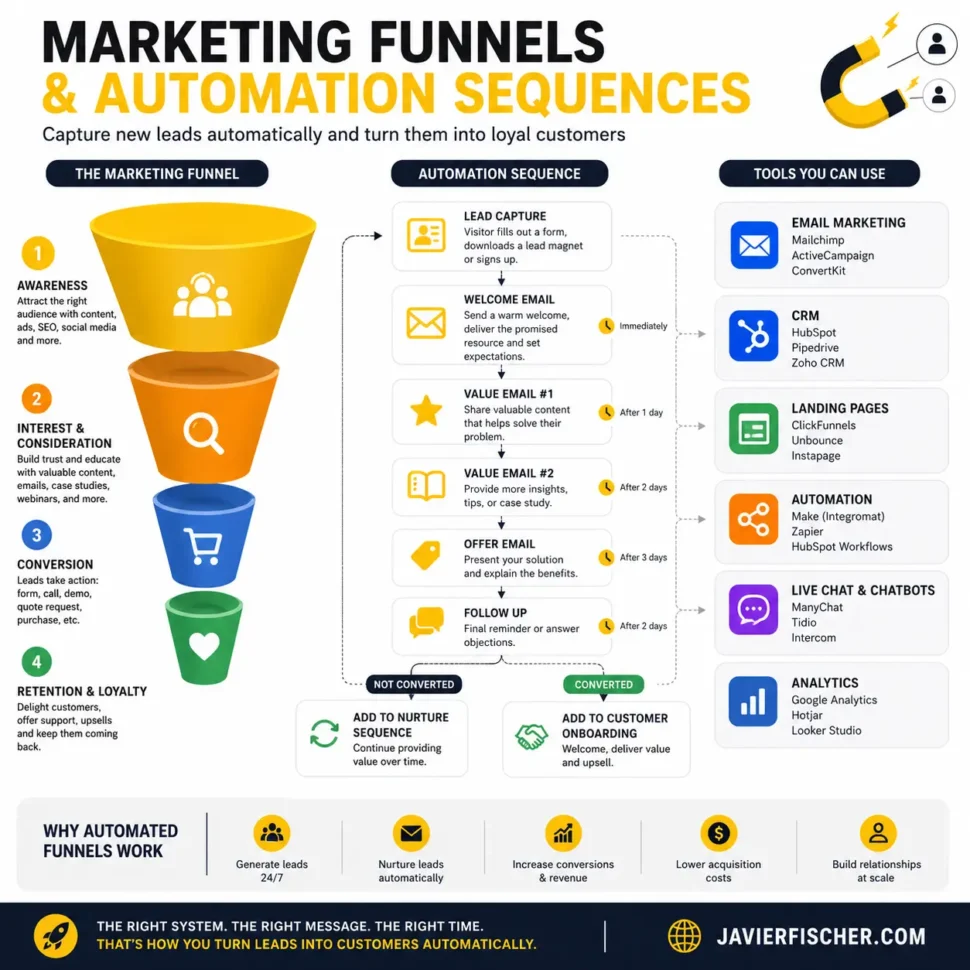
A marketing funnel represents the journey a person takes from discovering a brand to eventually becoming a customer.
It is called a “funnel” because many people enter the process, but only a percentage complete the final conversion.
The goal of a funnel is to guide potential customers through multiple stages using:
- Content marketing
- Paid advertising
- Automation
- Email marketing
- Retargeting
- Sales follow-up
- Landing pages
- CRM systems
Instead of relying on luck, businesses create a structured system for customer acquisition.
Why Marketing Funnels Are So Important
Without a funnel, many companies rely only on:
- Referrals
- Organic social media posts
- Random inquiries
- Website traffic without strategy
- Word of mouth
The problem is that these methods often produce inconsistent and unpredictable results.
A well-designed funnel helps businesses:
- ✅ Generate leads consistently
- ✅ Automate parts of the sales process
- ✅ Improve conversion rates
- ✅ Reduce customer acquisition costs
- ✅ Increase sales
- ✅ Identify where leads are dropping off
In other words, funnels transform marketing into a scalable system.
The Main Stages of a Marketing Funnel
1. Awareness & Attraction
The first stage focuses on attracting potential customers.
Businesses use channels such as:
- Google Ads
- SEO
- Meta Ads
- LinkedIn Ads
- Social media
- Blog content
- YouTube
- Video marketing
The goal at this stage is not immediate selling.
Instead, the objective is to capture the attention of people who may already have interest in the problem your business solves.
Examples:
- A medical clinic publishing educational content about treatments
- A law firm creating articles about legal issues
- A B2B company using LinkedIn to attract decision-makers
2. Interest & Consideration
Once users discover the brand, they move into the evaluation stage.
At this point, trust becomes critical.
Businesses often use:
- Case studies
- Testimonials
- Educational content
- Webinars
- Email marketing
- Retargeting ads
- Product demonstrations
- Landing pages
Many users still do not buy immediately, but they begin seriously considering the company.
3. Conversion
This is the most important stage of the funnel.
The conversion could be:
- Filling out a form
- Booking a meeting
- Requesting a quote
- Scheduling a consultation
- Purchasing a product
- Starting a free trial
The objective is to reduce friction and simplify decision-making.
This is why businesses need:
- Fast websites
- Optimized landing pages
- Clear calls-to-action
- Automation systems
- Effective sales follow-up
A poorly designed website can destroy otherwise successful advertising campaigns.
4. Retention & Loyalty
Many companies forget this stage.
However, existing customers are often the most valuable asset a business has.
A satisfied client may:
- Purchase again
- Recommend the business
- Increase average order value
- Become a long-term customer
Modern funnels therefore include:
- Email marketing automation
- Loyalty programs
- Retargeting campaigns
- Customer support
- Upsell strategies
- CRM follow-up systems
Common Types of Marketing Funnels
Lead Generation Funnels
Commonly used by:
- B2B companies
- Medical clinics
- Law firms
- Real estate agencies
- Financial professionals
- Service-based businesses
The goal is to generate qualified leads.
Direct Sales Funnels
Often used for:
- Ecommerce
- Digital products
- Online courses
- SaaS platforms
These funnels focus on faster conversions.
Automated Funnels
These systems use automation tools, CRMs, and email sequences to nurture leads automatically.
Remarketing Funnels
These funnels re-engage users who visited a website but did not convert.
Remarketing is one of the most effective ways to improve conversion rates.
Common Funnel Mistakes
Trying to Sell Too Quickly
Not every visitor is ready to buy immediately.
Not Tracking Data
Without analytics and conversion tracking, optimization becomes impossible.
Having Traffic but No Strategy
Many businesses generate website traffic but lack systems to convert visitors into leads.
Poor Landing Pages
A weak landing page can ruin profitable ad campaigns.
No Sales Follow-Up
Many leads are lost simply because businesses fail to respond quickly.
Tools Used to Build Marketing Funnels
Depending on the business model, companies commonly use:
- Google Ads
- Meta Ads
- Google Analytics
- CRM platforms
- Email automation software
- Landing page builders
- WhatsApp Business
- Chatbots
- Retargeting platforms
Which Businesses Need Marketing Funnels?
Almost every company that wants predictable client acquisition can benefit from funnels.
Especially:
- Medical clinics
- Lawyers
- Accountants
- Real estate agencies
- Construction companies
- SaaS businesses
- B2B companies
- Consultants
- Ecommerce brands
Funnels Help Businesses Scale
One of the biggest advantages of a well-designed marketing funnel is predictability.
Instead of depending entirely on referrals or inconsistent social media activity, businesses build systems capable of continuously attracting, converting, and retaining customers.
This is why marketing funnels have become one of the most important components of modern performance marketing.
Companies that understand funnels do not simply generate traffic.
They create systems that generate revenue consistently.