Building 6 Browser-Based 3D Games in a Weekend with Three.js and Claude AI
This weekend I ran a focused experiment with a simple but ambitious constraint:
Could I go from idea to six fully playable 3D browser games in a single development sprint using modern web technologies and AI assistance?
The answer was not only yes—it was a strong signal of where digital product development is heading.
Using Three.js, WebGL, and Claude by Anthropic, I built six distinct 3D games that run directly in the browser across desktop and mobile devices—no downloads, no installs, no friction.
What used to take weeks or months of iteration can now be compressed into hours when the right tools, systems thinking, and execution speed come together.
🎯 The Goal: Speed, Simplicity, and Execution
I wasn’t trying to build perfect, production-ready games.
I was testing something more important:
- How fast can ideas become interactive experiences?
- How far can AI accelerate real engineering work?
- Can modern WebGL tools support rapid multi-game prototyping?
- Where are the real bottlenecks today: code, creativity, or execution?
What emerged was a clear pattern:
The limiting factor is no longer technical capability—it’s decision speed.
⚙️ The Stack Behind the Experiment
The entire system was built using lightweight, high-performance web technologies:
- Three.js for 3D rendering and scene management
- WebGL for GPU-accelerated browser graphics
- Vanilla JavaScript for gameplay logic
- Claude AI by Anthropic for:
- game mechanics design
- code generation and refactoring
- debugging and error resolution
- rapid iteration of gameplay loops
- performance optimization suggestions
The key insight here is not the tools themselves—but the interaction between them.
AI did not replace development. It compressed iteration cycles.
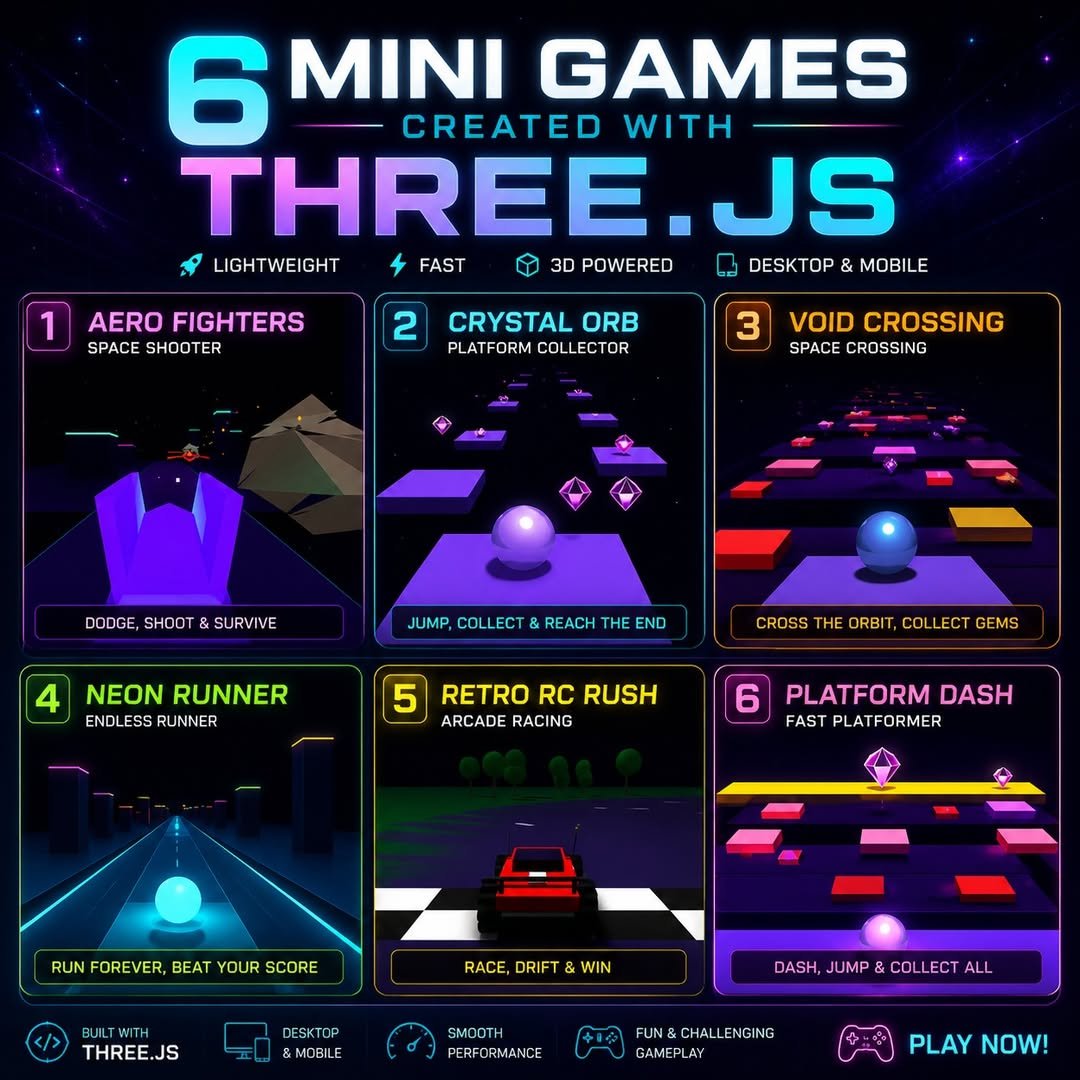
🎮 The 6 Games Built
Each game was designed around a simple core mechanic, ensuring rapid prototyping and clear gameplay loops.
🌌 Void Crossing
A space navigation platformer where players collect gems while traversing unstable orbital paths filled with hazards and gravity shifts.
Focus: timing, movement precision, environmental risk.
💎 Crystal Orb
A fast-paced 3D platformer where players control a glowing sphere, jumping across floating structures while collecting crystals.
Focus: momentum, control, spatial awareness.
🚀 Spore Fighter
An endless runner combined with combat mechanics. Players must dodge, jump, and shoot through waves of alien spores and dynamic obstacles.
Focus: reaction speed, survival loops, escalation design.
⚔️ Sky Battle – Plasma Wars
A futuristic multi-dimensional space shooter featuring high-intensity combat, plasma weapons, and layered enemy waves.
Focus: combat rhythm, spatial targeting, progression pacing.
✈️ Aero Fighters
A neon-inspired arcade air combat game with fast movement, retro-futuristic visuals, and continuous aerial dogfighting mechanics.
Focus: agility, tracking, arcade responsiveness.
🏎️ Speed Rush
A high-speed RC-style racing game featuring drifting mechanics, time trials, and increasingly technical track design.
Focus: precision control, velocity management, skill mastery.
🧠 Key Learnings from the Build
This experiment produced more than games—it produced insights about modern product development.
1. AI compresses the iteration loop, not creativity
Claude helped accelerate implementation, but every game still required clear mechanical intent. AI enhances direction—it doesn’t replace it.
2. Three.js enables “fast 3D thinking”
With Three.js, you can move from concept to visual prototype in minutes. That changes how you think about product design entirely.
3. Prototypes are the new products
In traditional workflows, a prototype is a step toward a product. Now, prototypes are the product validation layer.
4. Execution speed is the real moat
Ideas are abundant. Execution is not.
The ability to build six working systems in a short time window is more valuable than perfecting one over weeks.
⭐ Personal Favorites
While all six games were valuable experiments, three stood out:
🏎️ Speed Rush — most complete gameplay loop
🚀 Spore Fighter — strongest engagement curve
💎 Crystal Orb — best balance of simplicity and polish
Each one demonstrated a different dimension of interactive design, from precision mechanics to chaotic survival loops.
🌐 Why This Matters
We are entering a phase where:
- Development cycles are collapsing
- Browser-based 3D is production-ready
- AI is becoming a real engineering collaborator
- Small teams (or individuals) can ship multi-experience systems quickly
This combination changes the economics of building digital products.
What used to require a team can now be rapidly prototyped by a single builder with the right stack and mindset.
🚀 Final Thought
This experiment reinforced a simple but powerful idea:
The future belongs to builders who can combine systems thinking with accelerated execution.
Not just coders. Not just designers. But hybrid operators who can move from idea to interactive reality at high speed.
This is no longer about learning tools.
It’s about learning how to build momentum.
If you’re experimenting with AI-assisted development, game design, or rapid prototyping, I’d be genuinely interested in hearing what you’re building and how your workflow is evolving.